
Can You Use a Swamp Cooler Indoors Instead of AC?
November 10, 2026 3:48 pmCan you use a swamp cooler indoors instead of AC? In dry climates, yes: an indoor swamp cooler cools a room well as long as fresh air flows in and moist air has a way out. Premier Industries, Inc. has built evaporative cooling equipment in Phoenix since 1983, and the rules for using one indoors come from how these systems behave in real buildings.
Can You Use a Swamp Cooler Indoors in a Closed Room?
No. A swamp cooler in a closed room traps the moisture it creates, so humidity rises and the cooling effect fades.
An evaporative cooler is a fresh-air system, unlike recirculating AC. If a portable unit keeps pulling in the same indoor air, each pass adds moisture and the supply air gets warmer. The table shows how quickly output drops for a unit drawing 85°F room air as humidity builds.
| Room Humidity | Estimated Supply Air (85°F Room Air) | Temperature Drop |
|---|---|---|
| 30% | 72°F | 13°F |
| 40% | 74°F | 11°F |
| 50% | 76°F | 9°F |
| 60% | 78°F | 7°F |
| 70% | 80°F | 5°F |
Illustrative estimates use the Stull (2011) wet-bulb equation, sea-level pressure, and an assumed 65% pad efficiency.

How an Indoor Swamp Cooler Works
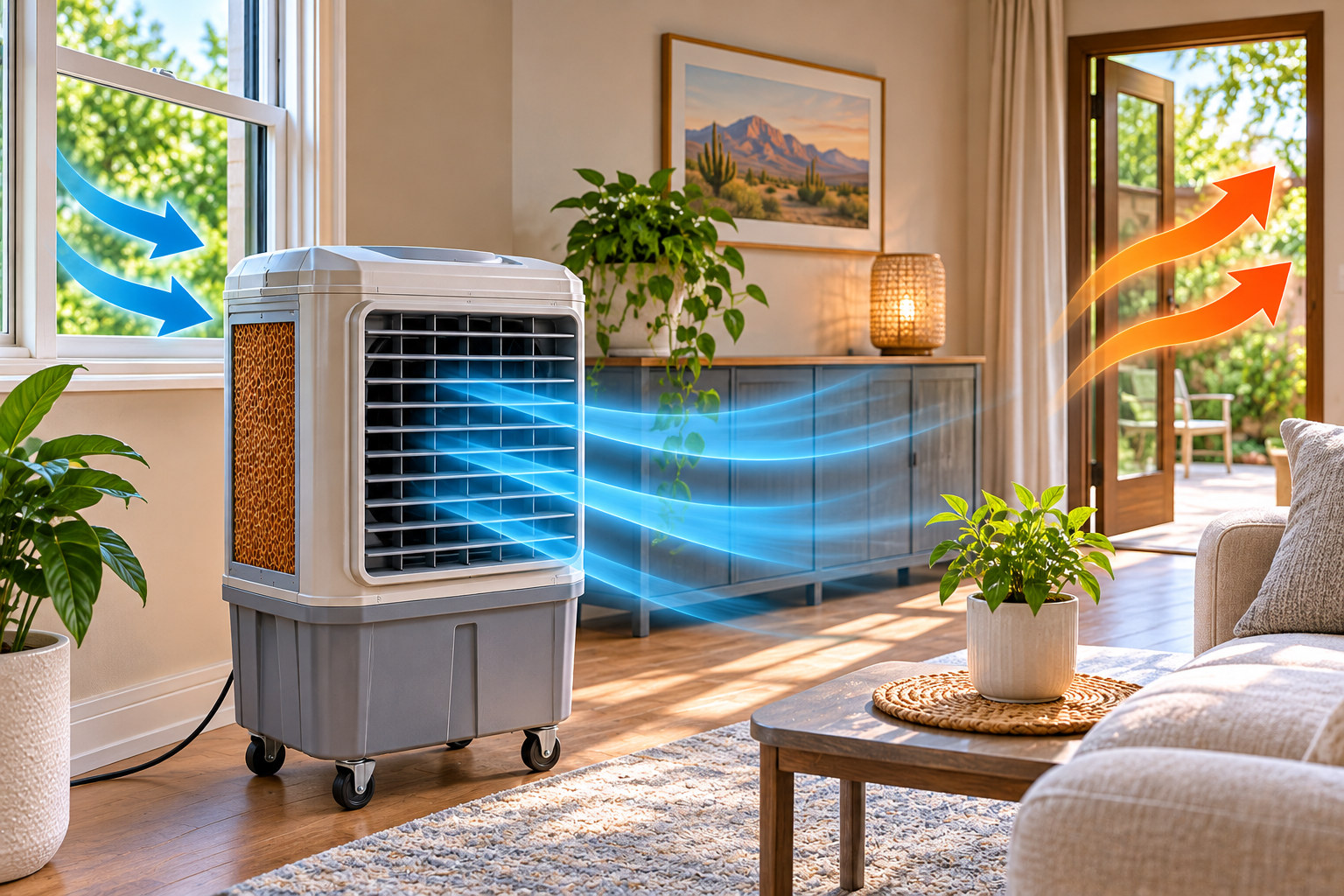
An indoor swamp cooler pulls air across water-soaked pads, and evaporation removes heat before a fan blows the cooler, moister air into the room. It needs only electricity and water, with no ducts or refrigerant.
Types of indoor evaporative coolers
| Type | How It Is Used Indoors | Premier Option |
|---|---|---|
| Portable | Roll into a room, add water, and plug in | movable spot-cooling units |
| Window-mounted | Sits in a window and cools one room or section of a home | whole-home cooling units |
| Ducted rooftop or wall unit | Delivers cooled air through vents to several rooms | direct evaporative cooling line |
The U.S. Department of Energy notes that small window units can cool a room or section of a home, while portable units on wheels provide only a slight cooling effect and are limited by the humidity in your home.
How to Set Up an Indoor Swamp Cooler
- Pick the room: Choose an area people use, with a window or door that can stay open.
- Create two openings: Crack one window or door where fresh air enters and another across the room where moist air leaves.
- Place the unit: Aim airflow toward where people sit, sleep, or work, near the fresh-air opening.
- Prime the pads: Fill the tank and let the pads soak before running at full speed.
- Monitor humidity: Use a hygrometer and keep the room below 60%, ideally between 30% and 50%.
Can you use a swamp cooler indoors without opening a window?
No, you need at least a small opening. Even a few inches of window gap gives fresh air a way in and moist air a way out. Without it, the room fills with humidity and cooling drops.
Signs an Indoor Swamp Cooler Is Adding Too Much Humidity
Too much humidity shows up as a room that feels sticky even though the air is moving. Watch for these signs and open another window or turn the unit off:
- Window condensation: Fogged glass or damp sills mean the air is holding more moisture than the room can shed.
- Musty smell: A damp odor signals moisture is settling into fabrics, carpet, or walls.
- Clammy air: The air feels warm and heavy instead of dry and cool, and the supply air is barely cooler than the room.
- Hygrometer above 60%: Treat the EPA’s 60% limit as the point to ventilate or switch to AC.
Dew point is a steadier number than relative humidity for planning, because it tracks the actual moisture in the air and does not swing with temperature through the day. Check local forecasts for dew point before running the unit overnight.
Best Rooms for an Indoor Swamp Cooler
| Space | Fit | What to Watch |
|---|---|---|
| Living room or den | Good | Keep a second opening across the room |
| Bedroom | Good, with care | Humidity can climb overnight, so crack a window and use a timer |
| Home office | Good | Keep airflow off paperwork and electronics |
| Garage or workshop | Very good | Large openings supply plenty of fresh air |
| Basement | Use caution | Already damp, so added moisture can raise mold risk |
For garages, shops, and large work areas where AC is impractical, see Premier’s warehouse, shop, and restaurant cooling.
Swamp Cooler vs AC Indoors: When to Switch
Use the swamp cooler in hot, dry weather and switch to AC when humidity rises. The U.S. Department of Energy says evaporative coolers cost about half as much to install as central air conditioners and use about one-quarter as much energy, but they should not be used in humid climates.
- Under 40% humidity: Run the swamp cooler with a cracked window or door.
- 40% to 60% humidity: Expect a smaller drop, increase ventilation, and watch indoor humidity.
- Above 60% humidity: Turn the swamp cooler off, close windows and doors, and run AC.
Using a swamp cooler and AC in the same home
You can use both, just not at the same time. Run the swamp cooler during the hottest, driest hours and switch to AC on milder days or in the evening when humidity rises. See estimated supply temperatures at every humidity level to judge when to switch, and use the swamp cooler where ducts do not reach, such as an addition or a garage.
Benefits and Limits of Indoor Evaporative Cooling
Benefits
- Lower energy use: About one-quarter the energy of central AC, per the U.S. Department of Energy.
- Added moisture in dry air: Eases dry skin and dry sinuses and helps protect wood and leather.
- Simple installation: Portable units need only power and water.
- No refrigerant: Fewer parts than a compressor-based system.
- Flexible placement: Move cooling to the room that needs it.
Limits
- Humid climates: Cooling falls off and indoor humidity rises.
- Ventilation required: Windows or doors must stay partly open.
- Seasonal care: The U.S. Department of Energy recommends a major cleaning every season, plus regular draining and cleaning to remove sediment and mineral buildup.
- Pad upkeep: Scaled or clogged pads reduce cooling, so fit new media sized to fit your unit when they wear out.
Choosing an Indoor Evaporative Cooler
Match the unit to the room volume, the humidity, and the ventilation you can provide. Compare airflow ratings with CFM charts and performance graphs, and review cooling pad options for pad choices that affect cooling and lifespan.
Premier checks humidity, airflow, and layout before recommending a unit, so talk with a Premier evaporative cooling specialist to find the right fit for your home or business.
Indoor Swamp Cooler FAQs
Can you run a swamp cooler in a closed room?
No. A closed room traps the moisture the cooler adds, so humidity rises and the cooling effect fades. Keep a window or door partly open so fresh, dry air enters and moist air leaves.
Do indoor swamp coolers need a window open?
Yes, at least a small opening. Crack a window or door a few inches, and open a second opening across the room when possible so air flows through the space.
Will an indoor swamp cooler make my house humid?
It adds moisture, which feels comfortable in dry climates and muggy without ventilation. The EPA recommends keeping indoor humidity below 60%, ideally between 30% and 50%, so monitor it with a hygrometer.
Can I use a swamp cooler and AC together?
Use them in turn, not at the same time. A swamp cooler needs open windows and doors, while AC works best in a closed space, so switch to AC when humidity is high or evenings turn muggy.
Can I use a swamp cooler in a basement?
Use caution. Basements are often already damp, and the added moisture can push humidity above the EPA’s 60% limit. Run it only in dry weather with good ventilation, and check humidity often.
Do indoor swamp coolers cause mold?
They can contribute to mold if indoor humidity stays above 60%, because the EPA links sustained high humidity to mold growth. Ventilation, a hygrometer, and drying out the unit between uses keep the risk low.
How much will an indoor swamp cooler cool a room?
At 95°F outdoors, the estimated drop is about 30°F at 10% humidity, 16°F at 40%, and 10°F at 60%. A portable unit that draws room air in a sealed space cools far less as humidity builds.
Is it safe to use a swamp cooler in a bedroom at night?
Yes, with a window cracked and humidity checked. Humidity often rises overnight, so use a timer or turn the unit off if the room feels damp or humidity passes 60%.
Do indoor swamp coolers work in humid weather?
Not well. Above about 60% humidity the cooler moves air but delivers only a few degrees of cooling and adds moisture. The U.S. Department of Energy advises against evaporative coolers in humid climates.
Categorised in: Evaporative Cooling
This post was written by Michael Nicolini