
How Do Portable Evaporative Coolers Work? Parts and Steps
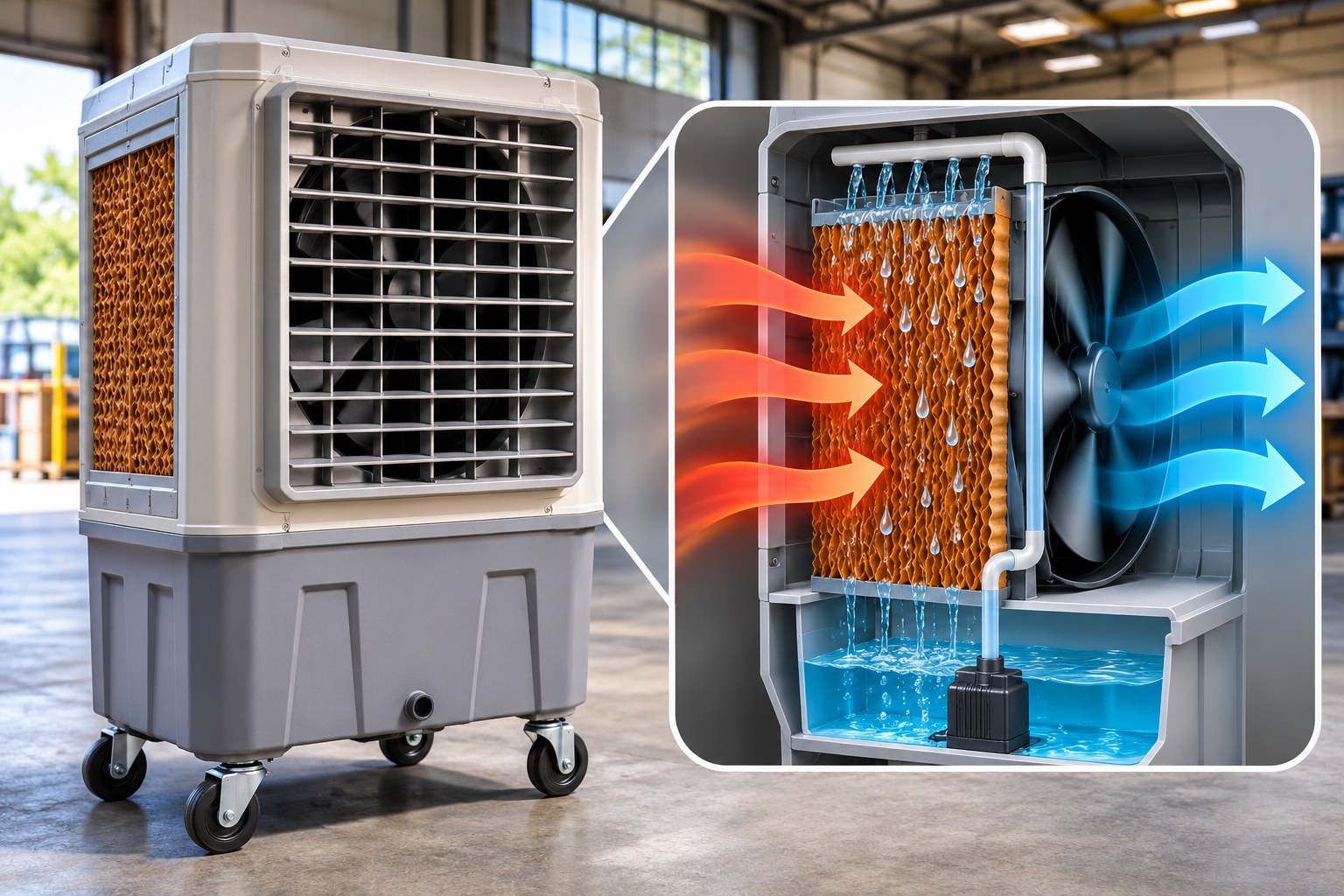
August 10, 2020 6:54 pmHow do portable evaporative coolers work? A fan pulls warm air across water-soaked pads, evaporation absorbs heat from that air, and the fan blows cooler, moister air into the room. Premier Industries, Inc. has built evaporative cooling equipment in Phoenix since 1983, and the same principle that powers rooftop systems drives every portable unit.
How Do Portable Evaporative Coolers Work Step by Step?
Portable evaporative coolers work in four steps: a fan draws air in, wet pads absorb its heat as water evaporates, and the fan pushes the cooler air out.
The process mirrors how sweat cools skin. Water changes from liquid to vapor, and that change pulls heat out of the air. Because there is no compressor or refrigerant, the unit needs only electricity and water, and the U.S. Department of Energy says evaporative coolers use about one-quarter as much energy as central air conditioning.
- No refrigerant: water evaporation does the cooling.
- About one-quarter the energy: compared with central AC, per the U.S. Department of Energy.
- Best under 40% humidity: relative humidity for strong cooling.
- Wheels or fixed: move spot cooling where it is needed.

Portable Evaporative Cooler Parts and What Each Does
Every portable evaporative cooler has the same five core parts. Knowing them makes it easier to compare models and troubleshoot weak cooling.
| Part | Job | Common Problem |
|---|---|---|
| Water tank | Holds the supply that feeds the pads | Sediment and mineral buildup |
| Pump and distributor | Moves water to the top of the pads | Clogged lines cause dry streaks |
| Cooling pads | Hold water so air can evaporate it | Scale, odor, or sagging pads |
| Fan | Pulls air through the pads and pushes it out | Weak airflow from dust or a failing motor |
| Level control and drain | Keeps the right water level and allows cleaning | Float or valve sticking |
How do portable evaporative coolers work inside the cabinet?
- Air enters: The fan pulls warm air from the room or outdoors toward the pads.
- Pads stay wet: The pump moves water from the tank over the pad surface.
- Water evaporates: Dry air absorbs moisture from the pads, and that evaporation removes heat from the air.
- Cooler air exits: The fan blows the cooled, more humid air into the space.
- Moist air leaves: An open window or door lets humid air escape so the cooler keeps pulling in fresh, dry air.
Are Portable Evaporative Coolers Effective?
Portable evaporative coolers are effective for spot cooling in dry air, and weak in humid air. The U.S. Department of Energy says portable units provide only a slight cooling effect and are limited by the humidity in your home.
Portable evaporative cooler performance by humidity
Supply air temperature depends on outdoor humidity and on how well the pads wet and evaporate water. The estimates assume 95°F outdoor air and two pad efficiencies, and the full range of estimated supply temperatures at every humidity level is available for other outdoor temperatures.
| Relative Humidity | Supply Air, Lower-Efficiency Pads (65%) | Supply Air, High-Efficiency Media (85%) | Temperature Drop |
|---|---|---|---|
| 10% | 72°F | 65°F | 23°F / 30°F |
| 20% | 77°F | 71°F | 18°F / 24°F |
| 30% | 80°F | 75°F | 15°F / 20°F |
| 40% | 83°F | 79°F | 12°F / 16°F |
| 50% | 85°F | 82°F | 10°F / 13°F |
| 60% | 87°F | 85°F | 8°F / 10°F |
| 70% | 89°F | 88°F | 6°F / 7°F |
Estimates use the Stull (2011) wet-bulb equation at sea-level pressure. The 65% and 85% efficiencies are assumptions, and actual output varies by unit and pad condition.
Where portable units work best
Dry, hot regions with low humidity suit them best, including much of the Southwest, the Mountain West, and the interior West. Humid coastal and Gulf climates are a poor match because the air already holds most of the moisture it can.
Do Portable Evaporative Coolers Need to Be Vented?
Portable evaporative coolers need no duct or exhaust fan, but they do need fresh air and an exit for moist air. Without ventilation, humidity climbs and cooling drops.
Unlike a sealed air conditioner, an evaporative cooler is a fresh-air system. Crack a window or door a few inches, and open a second opening across the room when possible so air flows through. The EPA recommends keeping indoor humidity below 60%, ideally between 30% and 50%.
Tips for getting the most from a portable evaporative cooler
- Run it on dry days: Check the forecast. Cooling is strongest in the dry afternoon and weakest on humid mornings.
- Prime the pads: Fill the tank and let the pads soak before running at full speed so the unit cools at full capacity.
- Use cool water: Cool or room-temperature tap water is fine. Ice is not required.
- Test the position: Place the unit so air reaches where people sit or work, with an open window nearby.
Portable vs Window vs Rooftop Evaporative Coolers
Portable units trade capacity for flexibility. Larger buildings usually need a fixed system sized for the whole space.
| Type | Installation | Best For | Premier Option |
|---|---|---|---|
| Portable | None. Plug in, add water, and roll into place | Garages, patios, workshops, and single rooms | movable spot-cooling units |
| Rooftop or wall-mounted residential | Fixed unit with ductwork | Whole-home cooling in dry climates | whole-home cooling units |
| Commercial | Fixed or roof-mounted with ducting | Warehouses, shops, and restaurants | warehouse, shop, and restaurant cooling |
| Industrial | Engineered for high airflow | Factories, plants, and large production areas | high-airflow factory and plant cooling |
Where portable evaporative coolers fit best
- Garages and workshops: Cool the work area without cooling the whole building.
- Patios and covered porches: Open air supplies the fresh air the cooler needs.
- Single rooms: Bedrooms, offices, and living areas in dry climates.
- Warehouse and shop floors: Spot cooling for workstations in large spaces.
When a space needs more capacity than a portable unit provides, Premier’s direct evaporative cooling line covers fixed systems from residential to industrial.
How to Choose and Maintain a Portable Evaporative Cooler
Features worth comparing
- Timer and remote: Shut the unit off automatically and adjust speed from across the room.
- Pad type: Several pad styles are available, and cooling pad options affect cooling and lifespan.
- Water tank and level control: A hose connector and automatic level control reduce refilling.
- Drain valve: Makes draining and cleaning the tank faster.
- Fan speeds: Multiple speeds let you balance airflow and noise.
Size the unit by airflow
Units are rated by the volume of air they deliver, in cubic feet per minute (CFM) or cubic meters per hour (CMH). One CMH equals about 0.59 CFM. Compare the rating with the volume of the space and the heat load, and review CFM charts and performance graphs when comparing capacity.
Clean and replace parts on schedule
The U.S. Department of Energy recommends draining and cleaning evaporative coolers regularly and doing a major cleaning every season. When pads are scaled, clogged, or sagging, fit new media sized to fit your unit, and add controls, motors, and accessories when an existing unit needs service.
Get an Evaporative Cooler Matched to Your Space
Premier Industries has supplied evaporative cooling systems and accessories to homes, businesses, and industrial facilities around Phoenix since 1983. To compare portable and fixed options for your humidity, airflow, and budget, talk with a Premier evaporative cooling specialist.
Portable Evaporative Cooler FAQs
How do portable evaporative coolers work?
A fan pulls air across water-soaked pads, and evaporation absorbs heat from the air. The fan then blows the cooler, moister air into the room. Portable units use only a fan, a pump, water, and electricity, with no refrigerant.
Do portable evaporative coolers really work?
They work best in dry air and for spot cooling. The U.S. Department of Energy notes that portable units provide only a slight cooling effect and are limited by the humidity in your home, so results depend heavily on climate.
How much cooler does a portable evaporative cooler make a room?
At 95°F outdoors and 10% humidity, estimated supply air is about 65°F to 72°F, depending on pad efficiency. At 60% humidity it is about 85°F to 87°F, so the benefit shrinks quickly as humidity rises.
Do portable evaporative coolers need to be vented?
They need no duct or exhaust fan, but they do need fresh air and a path for moist air to leave. Keep a window or door partly open, ideally with cross-ventilation, so humidity does not build up.
What humidity is too high for a portable evaporative cooler?
Performance is strongest below 40% relative humidity and weak above 60%. In the upper range the unit still moves air, but the air is only a few degrees cooler and adds moisture to the space.
What is the difference between a portable evaporative cooler and a portable air conditioner?
A portable evaporative cooler cools with water evaporation and adds humidity, while a portable air conditioner uses refrigerant and removes humidity. Evaporative units use far less energy but only suit dry climates.
What do I put in a portable evaporative cooler?
Fill the tank with clean tap water, and let the pads soak before running at full speed. Cool or room-temperature water works well, and some models connect to a garden hose for continuous refilling.
How often should I clean a portable evaporative cooler?
Drain and clean the tank regularly to remove sediment and mineral buildup. The U.S. Department of Energy recommends a major cleaning every season, and pads should be replaced when they are scaled, clogged, or damaged.
Can a portable evaporative cooler be used in a garage or workshop?
Yes. Garages, workshops, patios, and warehouse work areas are common uses because the open space supplies fresh air and the cooler targets the area where people work.
Categorised in: Evaporative Cooling
This post was written by Michael Nicolini