
How Much Water Does an Evaporative Cooler Use?
January 27, 2026 3:47 pmUnderstanding evaporative cooling water usage is essential for facility managers, homeowners, engineers, and sustainability professionals evaluating cooling solutions in hot and dry climates. Evaporative coolers, commonly referred to as swamp coolers, operate on a fundamentally different thermodynamic principle than traditional vapor compression air conditioners. Instead of relying on refrigerants and energy-intensive compressors, evaporative systems use the natural process of water evaporation to reduce air temperature. While this approach is significantly more energy efficient, it does require a consistent water supply. This raises an important technical and environmental question: how much water does an evaporative cooler actually use, and how can that usage be optimized without sacrificing performance?
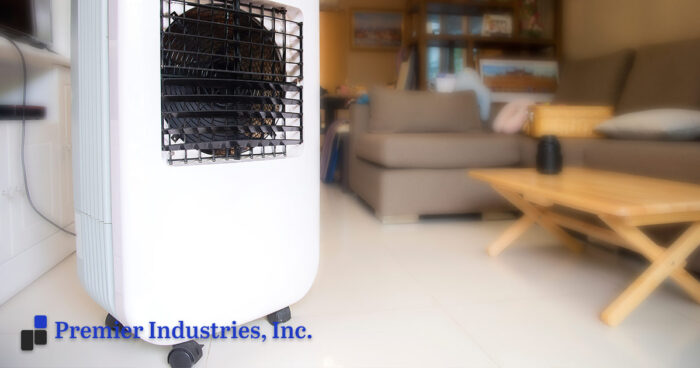
Average Evaporative Cooling Water Usage Explained
At a fundamental level, evaporative coolers consume water in proportion to the amount of heat they remove from the air. The cooling process occurs when hot, dry air is drawn through wetted cooling media. As water evaporates from the media surface, it absorbs latent heat from the air stream, lowering the air temperature before it enters the conditioned space.
On average, evaporative coolers use between 3 and 15 gallons of water per hour, depending on system size, airflow rate, and ambient conditions. Smaller residential units may fall at the lower end of this range, while large commercial or industrial systems designed to move tens of thousands of cubic feet per minute of air may exceed it.
To provide a more technical reference, water consumption is directly related to evaporation rate, which can be approximated by the following variables:
- Airflow volume measured in cubic feet per minute
- Difference between entering dry bulb temperature and leaving wet bulb temperature
- Saturation efficiency of the cooling media
- Ambient humidity levels
For example, a commercial evaporative cooler operating at 20,000 CFM with high efficiency rigid media achieving 85 to 90 percent saturation efficiency may evaporate approximately 10 to 12 gallons of water per hour under peak summer conditions in a desert climate. This figure represents evaporated water only and does not include additional water lost through bleed-off or blowdown cycles, which are used to control mineral concentration.
It is important to note that evaporated water is not wasted in the traditional sense. The water becomes water vapor and is released into the air, contributing to the cooling effect. Additional water losses typically come from system maintenance practices rather than the cooling process itself.
Factors That Affect Water Consumption in Coolers
Evaporative cooler water usage is not a fixed value. It fluctuates based on several interrelated design, operational, and environmental factors. Understanding these variables is critical for optimizing system performance while minimizing unnecessary water use.
The Role of Climate in Water Efficiency
Climate is the single most influential factor affecting evaporative cooler water consumption. These systems are most effective in hot, dry regions where the difference between dry bulb temperature and wet bulb temperature is large.
In arid climates such as Phoenix, Arizona, low ambient humidity allows for rapid evaporation, which improves cooling efficiency but also increases hourly water evaporation rates. However, because the cooling output per gallon of water is high, the overall water efficiency remains favorable when compared to other cooling methods.
In contrast, in humid climates, evaporation occurs more slowly. This reduces cooling effectiveness and may lead to higher total water usage over time for a given cooling load. As a result, evaporative cooling is generally not recommended for high-humidity regions.
Key climate-related impacts on water usage include:
- Higher ambient temperatures increase the evaporation rate
- Lower relative humidity increases evaporation efficiency
- Seasonal variations directly affect daily and monthly water consumption
From an engineering perspective, properly sizing the system for the local climate ensures that water usage aligns with actual cooling demand rather than exceeding it.
System Size and Airflow Rate
Larger systems move more air and therefore require more water to maintain fully wetted cooling media. Oversized units are a common cause of excessive water usage because they cycle unnecessarily or require higher bleed-off rates to manage mineral buildup.
Correct system sizing should be based on:
- Building heat load calculations
- Required air changes per hour
- Desired indoor temperature and ventilation rates
When airflow is matched precisely to the cooling requirement, water usage remains proportional and efficient.
Cooling Media Type and Efficiency
The type of cooling media used plays a critical role in determining water consumption. High-efficiency rigid-type cooling media, such as those engineered for industrial applications, provide greater surface area and longer air-water contact time. This allows for higher saturation efficiency with less total water flow.
Compared to traditional aspen pads, rigid media offer:
- Improved evaporation control
- Reduced water carryover
- Lower maintenance requirements
- More consistent wetting patterns
Systems equipped with high-efficiency media can achieve up to 90 percent cooling efficiency while using less water per degree of temperature reduction.
Water Quality and Bleed Off Rates
Mineral content in the water supply directly affects how often bleed off, or blowdown, is required. As water evaporates, dissolved minerals remain behind and concentrate within the system. Without periodic bleed off, scaling, and mineral deposits can reduce media efficiency and airflow.
Excessive bleed off increases water consumption beyond what is required for evaporation alone. Optimizing bleed-off settings based on water quality testing is essential for minimizing waste.
Tips to Reduce Water Usage in Evaporative Cooling
Reducing water usage in evaporative cooling systems does not require sacrificing performance. In fact, many water-saving measures also improve cooling efficiency and extend equipment life.
Proper System Design and Sizing
Accurate heat load calculations are the foundation of water-efficient evaporative cooling. Overdesigning airflow capacity leads to unnecessary evaporation and higher bleed-off requirements.
Best practices include:
- Conducting detailed building load analysis
- Selecting equipment with variable speed fans
- Designing ductwork to minimize static pressure losses
Regular Maintenance and Inspection
Poor maintenance is one of the leading causes of excessive water consumption. Leaking distribution lines, clogged pads, and malfunctioning float valves can significantly increase water usage without improving cooling output.
Maintenance procedures should include:
- Inspecting and cleaning water distribution headers
- Ensuring even media wetting
- Checking bleed-off controls and solenoid valves
- Removing mineral buildup from sumps and piping
A well-maintained system operates at peak efficiency, using only the water required for effective evaporation.
Advanced Water Management Controls
Modern evaporative coolers can be equipped with automated water management systems that optimize bleed off based on conductivity or total dissolved solids levels. These controls reduce unnecessary water discharge while protecting the system from scaling.
Benefits of advanced controls include:
- Reduced water waste
- Extended media life
- Lower maintenance costs
- Improved system reliability
Comparing Water Use: Swamp Coolers vs Air Conditioners
While evaporative coolers use water directly, traditional air conditioners consume water indirectly through electricity generation. Thermoelectric power plants require significant water for cooling and steam generation, especially in regions that rely on fossil fuels or nuclear energy.
When comparing total resource usage, evaporative cooling often proves more sustainable. Technical comparisons show:
- Evaporative coolers use up to 75 percent less energy than refrigerated air conditioning
- Indirect water consumption from power generation can exceed direct evaporative water use
- Peak electrical demand is significantly reduced with evaporative systems
From a systems engineering perspective, evaporative cooling shifts resource consumption from electricity to water, often resulting in a net environmental benefit in arid regions where water use can be carefully managed.
Eco-Friendly Cooling and Water Conservation
Evaporative cooling aligns well with sustainability goals when designed and operated correctly. By leveraging natural thermodynamic processes, these systems reduce greenhouse gas emissions associated with energy production while delivering effective cooling.
Water conservation strategies that support eco-friendly operation include:
- Using high-efficiency rigid media
- Optimizing bleed off rates
- Reusing bleed-off water for non-potable applications where permitted
- Implementing seasonal system adjustments
When combined with renewable energy sources or energy-efficient building design, evaporative cooling becomes a cornerstone of environmentally responsible climate control.
Partner with Premier Industries, Inc.
Evaporative coolers do use water, but the amount is highly dependent on climate, system design, media efficiency, and maintenance practices. In hot, dry regions, evaporative cooling water usage is not only predictable but also controllable through proper engineering and operational discipline. When compared to traditional air conditioning, evaporative cooling often delivers superior energy efficiency with a favorable overall resource footprint.
For over 30 years, Premier Industries, Inc. has been manufacturing evaporative coolers in Phoenix, Arizona, where extreme heat and arid conditions demand the highest levels of performance and efficiency. Our products feature stainless steel housings and high-efficiency rigid-type cooling media capable of achieving up to 90 percent cooling efficiency. We are happy to assist with both engineering and design, and we can design and build equipment to meet virtually any evaporative cooling, filtration, or air handling need. If you are looking for an efficient, reasonably priced, and innovative way to cool your home or commercial space, you need to look no further than Premier Industries, Inc. Contact us to speak with our experts and discover how a properly engineered evaporative cooling system can deliver powerful cooling while using water responsibly.
Categorised in: Evaporative Coolers
This post was written by Mike Nicolini
Comments are closed here.