
Swamp cooler humidity chart guidance from Premier Industries, Inc. helps homeowners, facility managers, contractors, and equipment buyers understand how relative humidity affects evaporative cooler performance. Evaporative air coolers, commonly called swamp coolers, work best in hot, dry climates because dry air can absorb more moisture as it passes through wetted cooling media. When humidity rises, evaporation slows down, and the delivered air temperature drop becomes smaller.
This is why evaporative coolers are so popular in dry regions such as Arizona, Nevada, New Mexico, West Texas, and other arid areas. The same system that can deliver strong cooling in dry air may feel weaker in humid weather because the air is already holding more moisture. If you are comparing cooling options, Premier’s swamp cooler vs AC guide explains how evaporative cooling compares with refrigerated air conditioning across humidity, operating cost, comfort, and climate fit.
“`
Swamp Cooler Humidity Chart for Evaporative Cooling Performance
A swamp cooler humidity chart helps estimate how much temperature drop is possible based on relative humidity. The lower the humidity, the more water can evaporate into the air, and the more heat can be removed. The higher the humidity, the less evaporation can occur, which reduces cooling output.
Swamp cooler humidity chart basics for better cooling decisions
At very low humidity, a swamp cooler can often produce a noticeable temperature drop. At moderate humidity, the temperature drop becomes smaller. At high humidity, evaporative cooling may still move air, but comfort improvement can be limited. If you are planning a new system, Premier’s evaporative cooler installation cost guide can help you evaluate equipment and installation decisions before investing in the wrong cooling approach.
Often supports a stronger temperature drop
Performance may still be useful but more limited
Cooling output usually drops significantly
Ventilation helps reduce excess indoor moisture
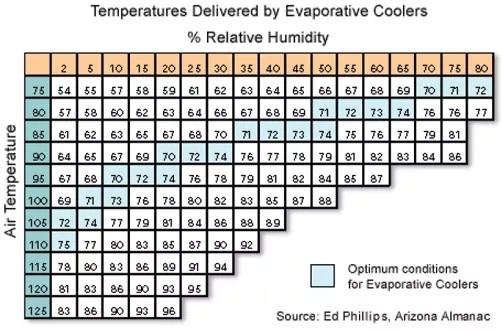
This chart helps estimate delivered air temperature based on outdoor temperature and relative humidity. Lower humidity usually means stronger evaporative cooling performance.
“`
How to Read a Swamp Cooler Humidity Chart
A humidity chart is used to estimate the relationship between outdoor temperature, relative humidity, and delivered air temperature. It does not replace equipment sizing, airflow review, or installation planning, but it gives a practical starting point for understanding why the same cooler performs differently from one day to the next.
“`
Start with outdoor temperature and relative humidity
Find the outdoor dry bulb temperature and current relative humidity, then use the chart to estimate the air temperature that may be delivered after evaporation. In simple terms, dry air gives water more room to evaporate. Humid air gives water less room to evaporate. That difference is why the same evaporative cooler may feel excellent during dry weather and weaker during muggy weather.
Low humidity
Low relative humidity allows more evaporation, which can create a larger temperature drop through the cooling media.
Moderate humidity
Moderate humidity can still allow evaporative cooling, but the expected temperature drop is smaller than in dry air.
High humidity
High humidity limits evaporation, so the cooler may move air but provide less meaningful temperature reduction.
Ventilation
Open windows, relief vents, and proper exhaust paths help moisture leave the space so cooling stays more effective.
Humidity readings change throughout the day
Humidity can shift from morning to afternoon and from one weather pattern to another. A cooler may perform better during the hottest, driest part of the day than it does during a humid morning or after a storm. For broader atmospheric background, NOAA’s humidity overview is a useful external reference for understanding moisture in the air.
“`
Will an Evaporative Cooler Work in High Humidity?
An evaporative cooler can still move air in high humidity, but cooling performance drops because evaporation is limited. Swamp coolers are designed to take advantage of low humidity. When the air is dry, it can absorb more moisture from the cooling media, which removes heat from the incoming air. When the air already contains a lot of moisture, the evaporation process slows down.
“`
Why swamp cooler humidity affects temperature drop
At 10 percent relative humidity, a swamp cooler may be able to drop the air temperature by roughly 20 to 30 degrees under favorable conditions. At 50 percent relative humidity, the same type of system may only lower the temperature by around 10 degrees, depending on outdoor temperature, media condition, airflow, and system design. At 60 percent relative humidity or higher, the comfort improvement may be modest unless ventilation and supplemental cooling are carefully managed.
| Relative Humidity | Typical Cooling Expectation | Planning Note |
|---|---|---|
| 10% to 20% | Strong evaporative cooling potential | Best range for noticeable temperature drop in dry climates |
| 30% to 40% | Moderate cooling potential | Useful cooling may still be possible with good airflow and ventilation |
| 50% | Reduced cooling potential | Expect a smaller temperature drop and more attention to ventilation |
| 60% or higher | Limited cooling potential | Supplemental cooling or dehumidification may be needed for comfort |
Use the chart before sizing equipment
If the local climate regularly has higher humidity during the cooling season, evaporative cooling expectations should be reviewed carefully. A larger unit does not always solve humidity limits because the cooling process itself depends on evaporation. Use the chart with Premier’s evaporative cooler CFM charts and specs when comparing equipment capacity.
“`
Why Swamp Coolers Do Not Work as Well in Humidity
Swamp coolers rely on a simple physical process: water evaporates into dry air, and that evaporation removes heat. The cooling media provides the wetted surface area where air and water interact. If the air is already close to saturated with moisture, less water evaporates from the media. Less evaporation means less heat removal.
“`
Cooling media needs dry enough air to perform
Evaporative cooling media is designed to hold water while allowing air to pass through. When the air is dry, the media can support strong evaporation. When air is humid, the media may still be wet, but less cooling occurs. This can lead some users to think the cooler is broken when the real issue is humidity, poor ventilation, or unrealistic performance expectations for the weather.
Humidity can also affect comfort indoors
Unlike refrigerated air conditioning, evaporative cooling adds moisture to the air. In dry climates, this can make the air feel more comfortable. In humid conditions, extra moisture may make the space feel muggy. Good ventilation helps because it allows humid indoor air to leave while fresh outside air continues moving through the cooler.
Media condition still matters
If humidity is low but performance is weak, inspect the media. Scaled, clogged, deteriorated, or unevenly wetted pads can reduce cooling even in ideal weather. Premier’s guide on how often to replace swamp cooler pads can help identify when media condition is limiting performance.
Water quality matters too
Hard water and mineral buildup can interfere with media wetting and airflow. If scale forms quickly, review Premier’s article on how water quality affects evaporative cooling performance.
“`
Ventilation Helps Control Swamp Cooler Humidity
Evaporative cooling systems need air movement through the space. They are not designed to operate like sealed, recirculating refrigerated AC systems. Fresh air enters through the cooler, passes into the building, and should have a path to leave through open windows, doors, relief vents, exhaust fans, or other ventilation openings.
“`
Air movement keeps evaporative cooling more effective
When humid air is trapped indoors, the cooler has a harder time maintaining comfort. Opening windows slightly or using vents allows moist air to escape. This helps keep the air inside from becoming overly humid and supports more consistent cooling. The right amount of exhaust depends on the unit size, building layout, and airflow path.
Open relief points
Cracked windows, doors, or relief vents give moist air a path out of the space.
Avoid sealed operation
Running a swamp cooler in a tightly closed space can trap humidity and reduce comfort.
Balance airflow
Too little exhaust can raise humidity, while too much exhaust can reduce the cooling effect in occupied areas.
Check duct paths
Duct restrictions, blocked vents, and poor air distribution can limit comfort even when the cooler is working.
Commercial and industrial spaces need airflow planning
Larger buildings often need a more deliberate air path than homes do. Warehouses, shops, service bays, and production areas may need exhaust fans, open doors, louvers, or makeup air planning. Premier’s commercial evaporative coolers, industrial evaporative coolers, and makeup air units can help frame larger airflow needs.
“`
Humidity Limits Temperature Drop
There is a major difference between hot and arid climates and hot and humid climates. In arid regions, a 20 to 30 degree drop may be possible under favorable conditions. In high-humidity areas, the drop may be closer to 5 to 10 degrees depending on the actual humidity level, outdoor temperature, equipment condition, and ventilation strategy.
“`
What affects evaporative cooler temperature drop?
- Relative humidity: Lower humidity allows stronger evaporation and a larger temperature drop.
- Outdoor temperature: Hot dry air often creates better evaporative cooling potential than warm humid air.
- Cooling media condition: Clean, properly wetted media supports better performance.
- Airflow volume: The unit must move enough air through the media and into the space.
- Ventilation path: Moist indoor air needs a way to exit the building.
- Water distribution: Dry streaks across the media reduce effective cooling surface area.
- Maintenance: Dirty sumps, clogged pads, mineral buildup, and poor bleed-off can reduce output.
Do not confuse humidity limits with equipment failure
If the cooler works well on dry days but feels weak on humid days, the issue may be weather conditions rather than equipment failure. If the cooler performs poorly even on dry days, inspect the media, pump, airflow path, water distribution system, and maintenance condition. Premier’s swamp cooler maintenance guide can help with seasonal checks.
“`
Does Evaporative Cooling Increase Humidity?
Yes. Evaporative cooling increases humidity because water evaporates into the air as part of the cooling process. In dry climates, that added moisture can be helpful and comfortable. In humid climates or poorly ventilated spaces, it can make the air feel damp or muggy.
“`
Swamp cooler humidity control depends on ventilation
The best way to manage added moisture is to keep air moving through the space. Evaporative coolers are fresh-air systems. They work by bringing in outdoor air, cooling it through evaporation, and pushing indoor air out through relief openings. Without that exit path, moisture accumulates and performance drops.
When dehumidification may help
In climates with frequent muggy conditions, a dehumidifier or supplemental cooling strategy may be needed for comfort. This is especially true when indoor humidity rises above comfortable levels or when a building cannot exhaust air effectively. In some applications, refrigerated air conditioning may be the better choice because it removes moisture rather than adding it.
Compare the right system for the climate
If your location has long periods of high humidity, review the swamp cooler vs AC comparison before selecting equipment. Evaporative cooling is highly effective in the right climate, but it is not the best fit for every environment.
Cost is only part of the decision
Evaporative systems can offer lower operating costs in the right conditions, but comfort depends on climate fit. The evaporative cooler installation cost resource can help with budgeting, while the humidity chart helps with performance expectations.
“`
Tips to Control Swamp Cooler Humidity
Humidity control comes down to airflow, maintenance, water management, and realistic climate expectations. A swamp cooler that is clean, correctly sized, and properly ventilated will usually perform better than one that is dirty, sealed inside the building, or operating in weather conditions that limit evaporation.
“`
Practical steps for better evaporative cooler performance
Maintain cooling media
Clean or replace media when it becomes clogged, scaled, damaged, or unable to hold water evenly.
Vent the space
Use open windows, relief vents, exhaust fans, or doors so humid air can leave the building.
Monitor humidity
Use a hygrometer to track indoor humidity and compare comfort levels with outdoor weather conditions.
Clean water systems
Keep the sump, filters, pump, and water distribution system clean so the media wets evenly.
Use proper bleed-off
Bleed-off helps reduce mineral concentration and can protect pads from scale buildup.
Compare equipment size
Use CFM charts and specifications to compare airflow before assuming the current unit is the right size.
Replacement parts can improve performance when humidity is not the issue
If outdoor conditions are favorable but the cooler still performs poorly, the issue may involve worn media, a failing wet section, or poor water distribution. Premier supports replacement evaporative cooler media, replacement wet sections, and evaporative cooling products and accessories.
“`
Use Humidity Data Before Choosing a Swamp Cooler
Humidity data should be reviewed before choosing a swamp cooler, especially if the unit will serve a home, warehouse, shop, agricultural space, commercial facility, or industrial building where comfort and airflow matter. The right cooler is not only the one with the right CFM. It also needs to match climate, ventilation, media, installation location, water quality, and maintenance expectations.
“`
Match the cooler to the application
| Application | Humidity Planning Priority | Helpful Premier Resource |
|---|---|---|
| Home cooling | Check local humidity and make sure the home can exhaust moist air | Residential evaporative coolers |
| Warehouse or shop cooling | Review airflow path, exhaust points, CFM range, and heat load | Commercial evaporative coolers |
| Industrial facility cooling | Evaluate high airflow needs, static pressure, ventilation, and climate fit | Industrial evaporative coolers |
| Flexible spot cooling | Consider local airflow, outdoor conditions, water access, and open ventilation | Portable swamp coolers |
Get help comparing humidity, airflow, and equipment fit
Premier can help customers compare evaporative cooler options by climate, airflow needs, media condition, installation type, and performance expectations. For direct guidance, contact Premier Industries or call 602-997-8754.
“`
Frequently Asked Questions About Swamp Cooler Humidity Charts
“`
What is the ideal humidity for a swamp cooler?
Swamp coolers usually perform best when relative humidity is below 40 percent. The lower the humidity, the more evaporation can occur and the larger the potential temperature drop.
How do I read a swamp cooler humidity chart?
Use the chart to compare outdoor temperature and relative humidity with expected delivered air temperature. This helps estimate how much cooling is possible under current weather conditions.
Will a swamp cooler work at 50 percent humidity?
A swamp cooler may still work at 50 percent humidity, but the temperature drop is usually much smaller than it would be in dry air. Ventilation becomes especially important at higher humidity levels.
Can I use a swamp cooler at 60 percent humidity?
At 60 percent humidity, evaporative cooling potential is limited. You may only get a small temperature drop, and supplemental cooling or dehumidification may be needed for comfort.
Does evaporative cooling increase indoor humidity?
Yes. Evaporative cooling adds moisture to the air as water evaporates from the media. Proper ventilation helps excess moisture leave the space so humidity does not build up indoors.
Why does my swamp cooler work better on some days than others?
Daily humidity changes can affect performance. A cooler will usually perform better during hot, dry weather and feel weaker during humid weather, even if the equipment is working properly.
How can I reduce humidity from a swamp cooler?
Open windows, use relief vents, improve exhaust airflow, keep the water system clean, and avoid running the cooler in a sealed space. In muggy climates, dehumidification or another cooling strategy may be needed.
Can dirty pads make humidity problems worse?
Dirty or scaled pads can reduce airflow and unevenly distribute water, which may weaken cooling and contribute to poor comfort. Inspect and replace pads when cleaning no longer restores performance.
Should I choose a swamp cooler or AC in a humid climate?
In consistently humid climates, refrigerated air conditioning is often better for comfort because it removes moisture instead of adding it. Evaporative cooling is usually strongest in hot, dry climates.
“`
Get a Quote