
Evaporative cooling resources help buyers, facility managers, and technicians compare equipment, validate performance, and solve common installation and maintenance questions. Use this hub to access specs, airflow charts, humidity guidance, wiring diagrams, and FAQs, then jump directly to product families and replacement parts.
Quick Links for Specs, Performance, and Troubleshooting
If you need performance validation, start with airflow and CFM charts. If you are selecting equipment, use the specs and drawings pages. If you are troubleshooting or doing a switch replacement, use the wiring diagram resource.
Evaporative Cooler Specs & CFM Performance Charts
Compare airflow and performance
Evaporative Cooler Specs & Drawings
Dimensions and technical detail
Swamp Cooler Humidity Chart & Tips
Optimize by climate conditions
For additional technical background on heat and humidity, reference NOAA’s humidity overview here: NOAA: Humidity basics.

Find the Right Resource Fast
Use these paths depending on what you are trying to accomplish. This keeps research clean and prevents jumping between unrelated pages.
If you are selecting equipment
- Use specs and drawings to confirm dimensions, fit, and layout requirements
- Use CFM performance charts to validate airflow and expected coverage
- Use humidity guidance to set realistic cooling expectations for your region
If you are troubleshooting or maintaining
- Start with FAQ for fast diagnosis and common fixes
- Use wiring diagrams when replacing a switch or verifying electrical connections
- Review cooling media information when performance drops or airflow is restricted
Core Concepts That Affect Performance
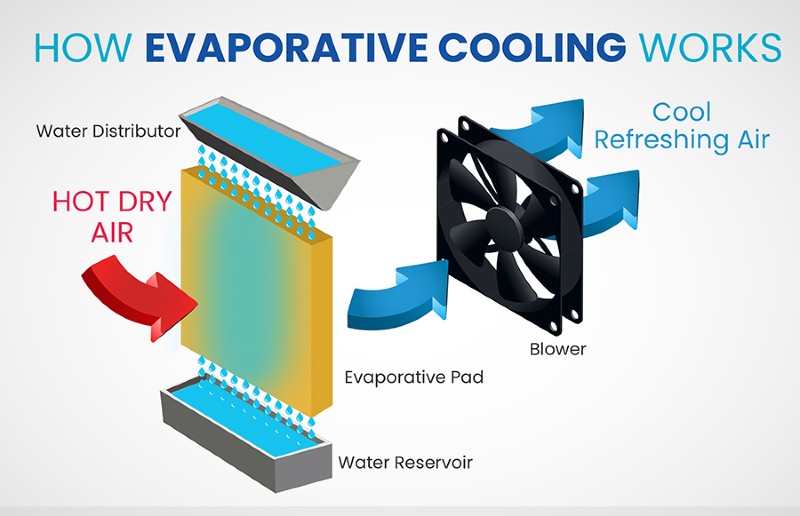
Evaporative cooling performance depends on airflow, wetted media condition, and relative humidity. The most common performance issues are caused by restricted airflow, uneven water distribution, scaled media, or incorrect expectations for humidity conditions.
Performance levers to understand
- Airflow volume and static pressure
- Media saturation and even wetting
- Water quality and mineral scaling
- Humidity conditions and ventilation strategy
Common expectation mismatch
Evaporative cooling is strongest in hot, dry climates. If humidity rises, temperature drop decreases. That is why climate guidance and performance charts should be used together during selection.
Common Questions
Do evaporative coolers work in humid climates?
Performance is strongest in hot, dry climates. When humidity rises, the achievable temperature drop decreases. Use the humidity resource and performance charts to set realistic expectations for your region.
What causes weak cooling performance?
The most common causes are restricted airflow, uneven water distribution, scaled or worn cooling media, or ventilation that is not matched to the space. Start with the FAQ, then confirm airflow with charts and inspect media condition.
How often should cooling media be replaced?
Replacement timing depends on water quality, usage, and maintenance. If you see scaling, warping, reduced cooling even with proper water flow, or persistent odor concerns, replacement media can restore performance.
Where do I find specs and drawings for a specific unit?
Use the Specs & Drawings page for dimensions and technical details, and use the Specs & CFM Performance Charts page to validate airflow and performance for selection.